





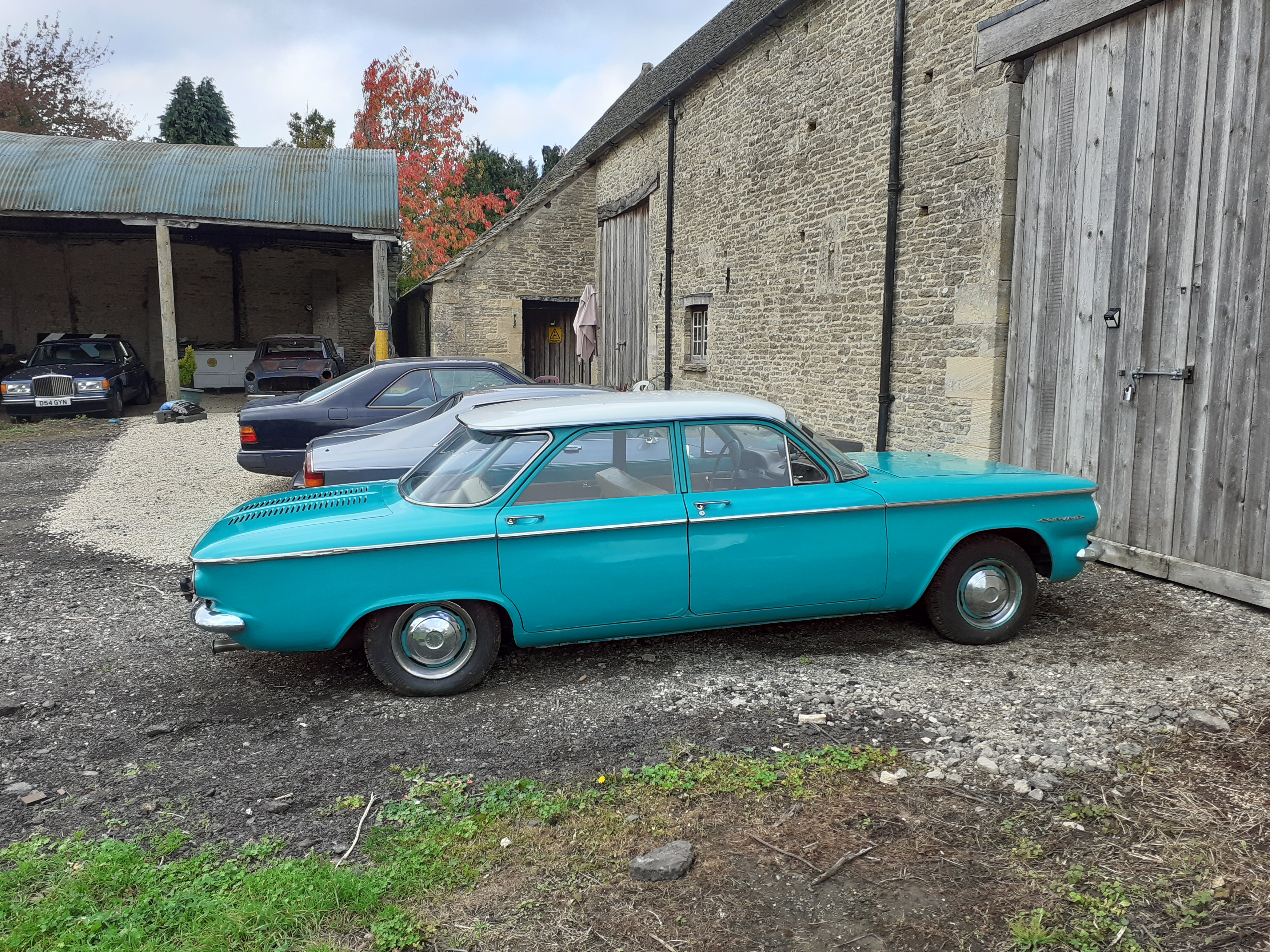

The Chevrolet Corvair was the 1960 response of General Motors to the substantial influx of low-priced European economy cars into the North American market in the late 50s and early 60s.
Before the Corvair, American cars came in just one size, huge, but Chevrolet recognised the need for a more rational, domestic vehicle that could serve the needs of an expanding suburbia wherein two or even three car families were increasingly common.
In particular, the thrifty and well-made VW Beetle scared Detroit because it appealed to an increasing number of American buyers who did not want, or need, a vast 11mpg sedan with rocket ship styling that became obsolete every 12 months. Built for nine years, the Corvair would contribute to changes in the American auto industry more than any other single car, although not in the ways its creators intended or would have wanted.
By European standards, the Corvair was not really a small car, but it was neat, low slung, and sophisticated, with much glass and no tail fins. Its styling was widely copied in Europe, scaled down to true mini-car size of the NSU Prinz and Hillman Imp, among others. The ‘unibody’ structure, without the traditional chassis, was a rarity in the American motor industry and the car was light and roomy inside. There was plenty of ‘Un-American activity’ under the skin too with a rear-mounted air-cooled flat-six engine (like a Porsche) and fully independent suspension. All this sophistication in a $1,900, 90mph family saloon that cost only a few hundred dollars more than the much smaller, slower, and less comfortable VW that had inspired it.
In all respects the Corvair was far removed from the general run of American cars (its ‘compact’ rivals from Ford and Chrysler which were really just scaled-down large cars) and it handled differently too, in a tail-happy way that appealed to string-back-glove-wearing European sports car ‘buffs’ but was unfamiliar to American drivers brought up on traditional American front-engined cars.
The early 80bhp versions were austere runabouts but, as it dawned on Chevrolet that there was an enthusiastic following for the car, it launched more exciting coupe and convertible versions; the 115mph Monza Turbo was one of the world’s first production turbo charged cars. In fact, the Corvair was developed into a full line-up of saloons, coupes, station wagons, pick-ups, and panel vans. But not everyone loved the Corvair. The controversy surrounding the handling of the early models inspired a young lawyer and automotive safety campaigner (and future four-times presidential candidate) called Ralph Nader to author the book called Unsafe at Any Speed. In it, he devoted a chapter to the alleged instability of the Corvair and its involvement in one-car ‘flip-over’ accidents attributed to the design of its rear suspension. Nader, who could drive but had little understanding of how automobiles functioned, postulated that, for want of a few Dollars’ worth of parts, the design of the car’s rear swing axles (a basic form of independent rear suspension also used by VW, Porsche, Mercedes, and many others) had been compromised. To an extent this was true, but perhaps more importantly buyers had little idea of how sensitive the Corvair’s handling was to tyre pressures: front-to-rear they were quite different.
His 1965 book was a best seller that made Nader’s campaigning reputation and began a new era of government automotive safety regulation and consumer awareness that forced big corporations such as General Motors to face up to their ‘safety responsibilities’. This was an era when ambitious senators in Lyndon B. Johnsons’ ‘progressive’ administration were looking for ‘do-gooder’ campaigns to fund and to hitch their wagons. In this liberal atmosphere big business was seen as the enemy, and business did not get any bigger than General Motors.
When GM discovered that this young lawyer was out to trash the reputation of the Corvair it hired a private eye to tail him and compile a dossier of sleaze. Unfortunately for them, Nader was so clean-living they couldn’t get anything on him; he lived like a monk and remained impervious to the attractions of alcohol, money, or sex. General Motors were forced to apologise publicly for this campaign of intimidation. Nader tried to sue them for $26 million dollars but settled out of court for $500,000.
More importantly, Chevrolet changed the design of the rear suspension to cure the Corvair’s handling peculiarities in extreme situations. Years later, Nader admitted that fumes from the Corvair’s petrol burning interior heater probably caused more accidents than the allegedly ‘unsafe’ rear suspension design. Even in 1964 plans were already in-hand to kill the Corvair which, after some initial success, was struggling against overwhelming competition from the wildly successful 1964 Ford Mustang.
However, General Motors realised that stopping production shortly after Unsafe at Any Speed was published would look like an admission of guilt. To save face the Corvair was allowed to stay on until 1969, with a new and very elegant restyle for 1965. With 1.8 million sold in ten years it would not be fair to call the Corvair a failure and for many years it has had a large cult following in America.
The final twist in the Corvair story was a 1971 Federal report on automobile safety which entirely exonerated the car’s handling. 1971 was also the year of Ford’s new baby car, the infamous Pinto, a vehicle apt to explode in certain types of rear-end impact. It was much more deserving of Ralph Nader’s attention than the poor old Corvair. Without the work Nader had done on the Corvair the much more fatal flaws inherent in the Pinto may never have publicly come to light. Perhaps Nader realised the debt he owed the Corvair. He mellowed in later years on the subject and even gave a speech to 6,500 Corvair fans at the Corvair Society of America’s 1991 Washington convention.