

From Coventry to Tehran
Even in 1967 there was nothing new about British motor makers sending their technology out to far-flung corners of the globe to assist in kick-starting local automotive activity. Nissan, in Japan, got its first leg-up building 1950s Austin saloons. Going back further still, the first BMW’s were Austin 7’s built under license. These are just two of many examples, but one of the oddest, and least well-known, is the story of the Iranian built Paykan.
It started life in the British midlands as the 1966 Hillman Hunter, a car nobody under 50 will remember (or probably want to remember if they are over fifty) and which has now virtually disappeared from UK roads.
Paykan is Iranian for ‘arrow’, the link being that the Hunter was part of the Rootes group’s new-for-1966 family of cars codenamed ‘Arrow’. The range included now long-forgotten Humber and Singer variants, the posh badge engineered Sceptre and Gazelle.
Sixty years ago, the most remarkable thing about the Hunter was its utter unremarkableness. Here was a typical mid-century three-box mid-sized British family saloon built to take on the Ford Cortina as a basic front engine/rear drive repmobile. This is a role it fulfilled with reasonable success between 1966 and 1979, latterly as the Chrysler Hunter after the complete take-over of the English family run business by the American giant. It is worth remembering that the once substantial Rootes combine did not go out of business making boring cars like the Hunter. It was the failure of the Hillman Imp, compounded by Harold Macmillan’s insistence that the car had to be built in Scotland, which finished off the Rootes Group. In other words, a classic cautionary tale on the dangers of political interference in car making.
If the baby Imp was an anomaly, the Hunter was classic Rootes fare. Its neat styling was partly attributed to William Towns, who later went on to design the outrageous 1976 Aston Martin Lagonda. But the 90mph, 25mpg Hunter was no Aston Martin: it was as boring to drive as it was to look at. But No car is all bad: it got good notices for its ventilation (which perhaps eased the discomfort when your drip-dry nylon shirt was stuck to its plastic seats on a sweltering summer day) and was also strong (proven by its outright victory in the car wrecking 1968 London-to-Sydney Marathon). This made it an ideal candidate for the rough, dusty roads of Iran.
It was here that Rootes’ rugged reputation had attracted the attention of the Khayani brothers of the Iran National firm. They built Mercedes trucks under licence but saw a market for a private saloon suited to local conditions. They had, in fact, been in negotiations with Rootes since the early sixties. Supported by government grants, the brothers finally struck a deal to import the new Hunter in knocked-down kit form for local assembly. The cars would literally arrive from Coventry, England in giant wooden crates, reduced to major component parts. Production started in May 1967 with an aim to build 6,000 units a year on assembly lines shipped from the UK.
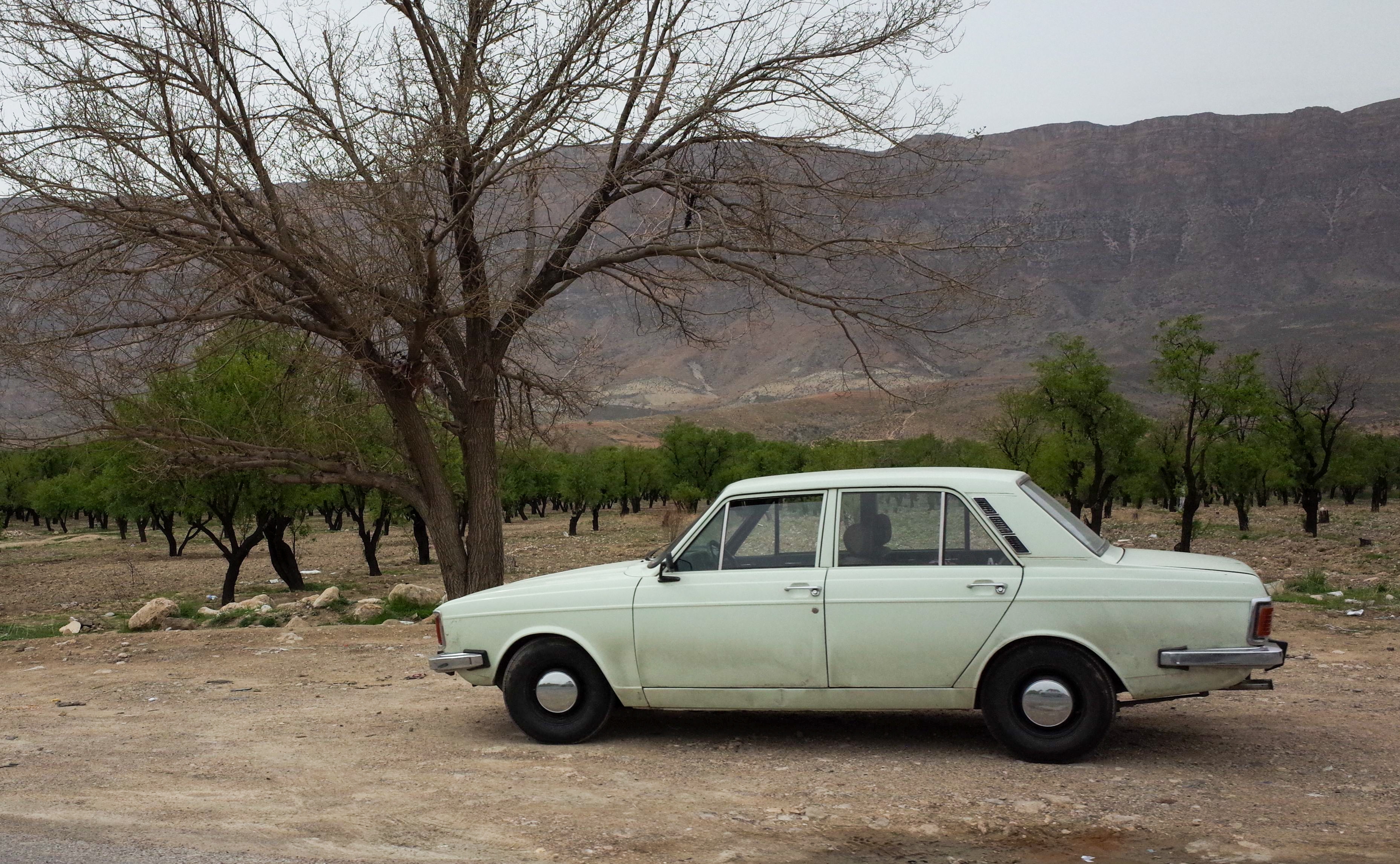
The Paykan, ‘a gift to the nation’, was promoted like any western car in those pre-revolution years; brochures featured men in suits, and women in miniskirts with full hair and make-up. There were pick-up and estate variants as well as civilian models. Available in a full range of colours (white was popular), the Paykan was seen as a classless automobile, a popular taxi cab but also a mini limousine, as used by the Iranian prime minister.
By the time the Ayatollah Khomeini’s revolution kicked off in 1979, production of the Paykan had boomed to 100,000 cars a year with 44% local content. Former British Leyland executive George Turnbull played a vital role in getting the Paykan as near 100% locally built as possible (fresh from setting up Hyundai for the Koreans, so he knew what he was doing) and securing a supply of major components. Later versions had Peugeot engines, Peugeot suspension, and were subject to various mild facelifts.
In a dozen years the price of a new Paykan had hardly changed and it had done much to establish the idea of an Iranian middle-class. But now the Khayani’s were urged to hand over control of the Paykan factory to the government. Like the Shah, they went into exile in France. The firm was renamed Iran Khodro and, under the austere gaze of the Khomeini regime, the Paykan range was made more basic with no wooden dashboards or fancy chrome that might weaken morals.
Production continued until 2005 (the pick-ups went on until 2015) when it was reckoned that 40% of the cars on Iranian roads were Paykans. Right up to the end there was a two-year waiting list. In the face of opposition from vastly more modern, locally built cars, the Paykan was seen by some as a national embarrassment; boxy, slow, and environmentally unfriendly. And yet, others looked at it wistfully as a simple car from simpler times that gave loyal service to millions.
That feeling has grown and today enthusiasts restore, customise, and tune-up what is still regarded as the true ‘national car’ of Iran, about which books would be written and TV documentaries made such was its pre-eminence in the modern history of the country.