





Austin Atlantic
The Austin A90 Atlantic was an English idea of what we thought the Americans wanted in a motor car in 1948.
Its dodgem front-end style (no traditional grille, just a slot with a Cyclops fog light in the middle) hardly did justice to the rounded elegance of its rear view.
The pre-production prototype Atlantic, finished in light blue, was sprung upon an astonished world at the 1948 Earls Court Show. It was one of the undoubted stars of the event and a shocking departure for the normally dependable but dour men of Longbridge. This was not an apologetic grocers saloon painted in regulation black, but a big, bold, two-door convertible offered in a variety of ritzy colours. Its American-style flashing indicators were not yet legal in Britain (and would not be until 1956), and what other 1948 car had warning lights on the dash to tell you a brake light bulb had blown?
That was not all. The Atlantic had a rev counter, built-in hydraulic jacks, a heater as standard, and offered the near unimaginable decadence of electro-hydraulic power windows and roof as options. The pump for the windows was an adapted Lucas starter motor. At £40 each these extras boosted the price to a still far from unreasonable £824.
Once production started in January 1949, the focus of the car, like everything else at that first post-war motor show, was on earning the mighty American dollar. It was strictly export only, the clue being in the name.
The A90 part of its nomenclature referred to the rounded-up 88bhp output of its 2660cc four-cylinder engine but could equally have been an indication of its top speed; the high geared Atlantic was good for an easy 95mph, making it one of the fastest British production cars.
For once the brochure copywriter’s claims of ‘Sports Car performance with saloon car comfort’ rang true.
It had a 72mph third gear and would waft along at 3000rpm for the same engine speed in top gear. For once the brochure copywriter’s claims of ‘Sports Car performance with saloon car comfort’ rang true. Given the American enthusiasm for British roadsters, it did not seem an unreasonable extrapolation on the part of Austin boss Leonard Lord that the Yanks would take the plusher, faster Atlantic to their hearts.
The origins of the car lie in a Pinin Farina-bodied Alfa 2500 cabriolet shown by the Italian coach builder at Geneva in 1946. Len Lord took a fancy to the Alfa and had it shipped to Longbridge. Here it was to serve as inspiration to his chief stylist Dick Burzi, the Argentinian former Lancia employee who had left Italy in a hurry 20 years earlier after upsetting Mussolini with his political cartoons.
Lord had allegedly sketched the first draft of what he wanted for his new ‘16hp Sports Model’ on the back of a fag packet. Certainly, the first hand-built prototype Atlantic of March 1948 – and the production versions – owe something to that Alfa show car. For production, the foot-operated door handle and split screen were discarded in favour of conventional handles and a three-piece screen with separate curved sections of glass either side. Some likened the distortions these generated to a fairground hall of mirrors.
Looking to his American buyers, Lord insisted on big, wide opening doors. The chassis came from Austin’s A70 family saloon complete with hydro-mechanical drum brakes (the rears were rod operated) but the parts sharing saved time getting the Atlantic into production and kept the price competitive.
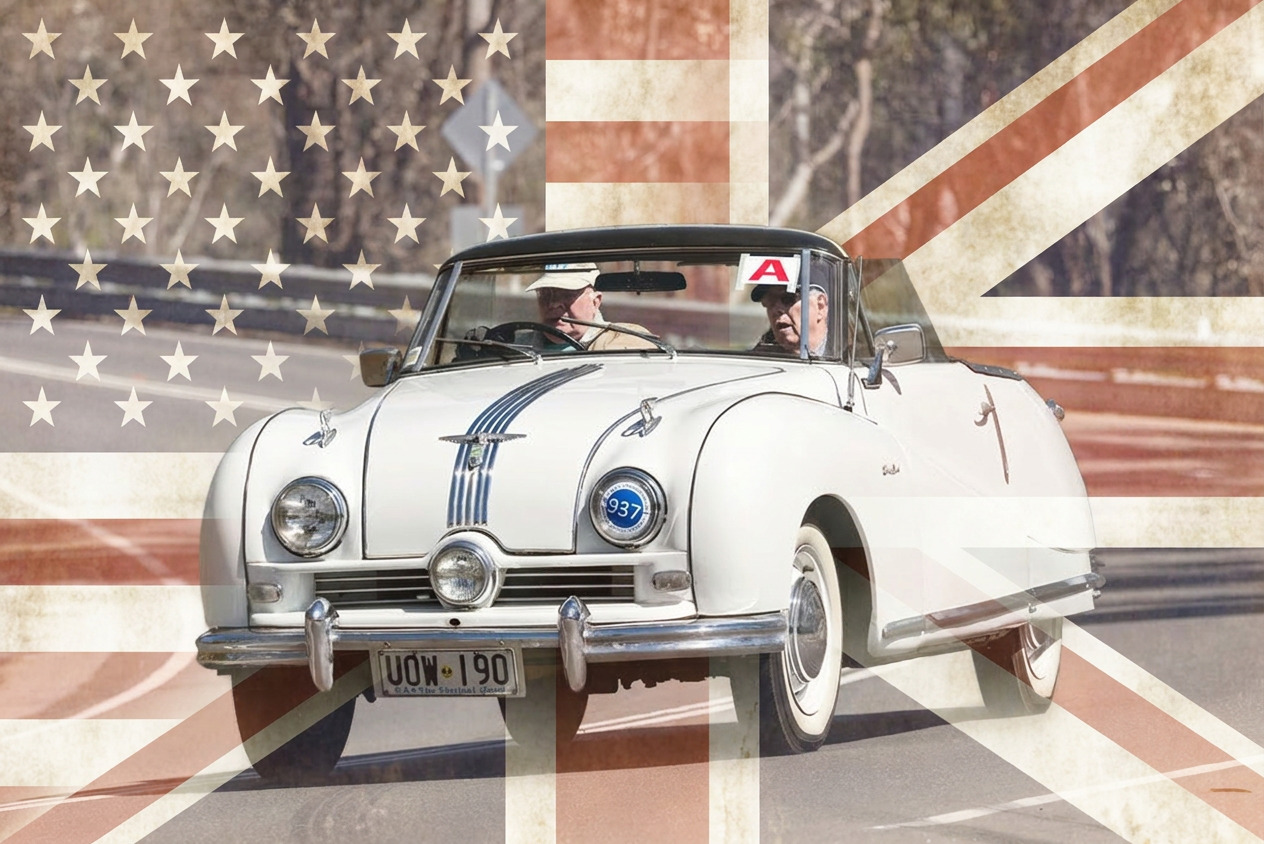
Sales started in 1949 but the Americans, mistrustful of four-cylinder cars, only took 350 Atlantics. Not even the famous seven-day assault on the American stock car records by Austin’s publicist Alan Hess at Indianapolis (at a 72.54 mph average) captured buyers’ imaginations, or a $1,000 price cut that, percentage wise, was one of the largest in motoring history.
Lord was quick to acknowledge his misjudgement and redirected the Atlantic at other markets with a certain amount of success in Australia and New Zealand. The car found its most enthusiastic audience in the UK, particularly once the sports saloon version appeared in 1949.
The fixed-head models now had fully hydraulic brakes, a more usable rear seat, and was generally reckoned to be a more sensible choice for the changeable British climate and its more reserved buying audience, who had a tendency to order their Atlantic saloons in black.
The saloons were adapted directly from unsaleable convertible bodies with a synthetic faux-leather roof finish. Its party trick was a rear window with a centre section that could be pulled down for ventilation. The Atlantic saloons quietly edged the convertibles out of the picture until their official demise in January 1951. Fixed heads carried on for a year and are thought to outnumber the convertibles in the 7981 unit total production: no exact figures exist. The Austin Counties Car Club thinks that only 60 cars survive in the UK with maybe another hundred accounted for around the world.
Drive an Atlantic today and it doesn’t seem to do anything in a hurry but, in the context of nearly 80 years ago, they were fast: irritatingly so to the owners of certain sports cars who were quick to decry the Austin’s handling as ‘greased blancmange’ without ever driving one. Others eyed the level of comfort they offered as something almost degenerate. Even the big flat split-bench front seat seemed to challenge the morals of the fifties with its ‘courting’ possibilities.
It was a car that became a lazy metaphor for misplaced post-war optimism and bad market research.
Today the Atlantic is a cheerful car that makes pedestrians and other motorists smile. It was a car that became a lazy metaphor for misplaced post-war optimism and bad market research. 78 years on, the Atlantic has found its place as a rare and surprisingly valuable prize in the world of early post-war British classics.